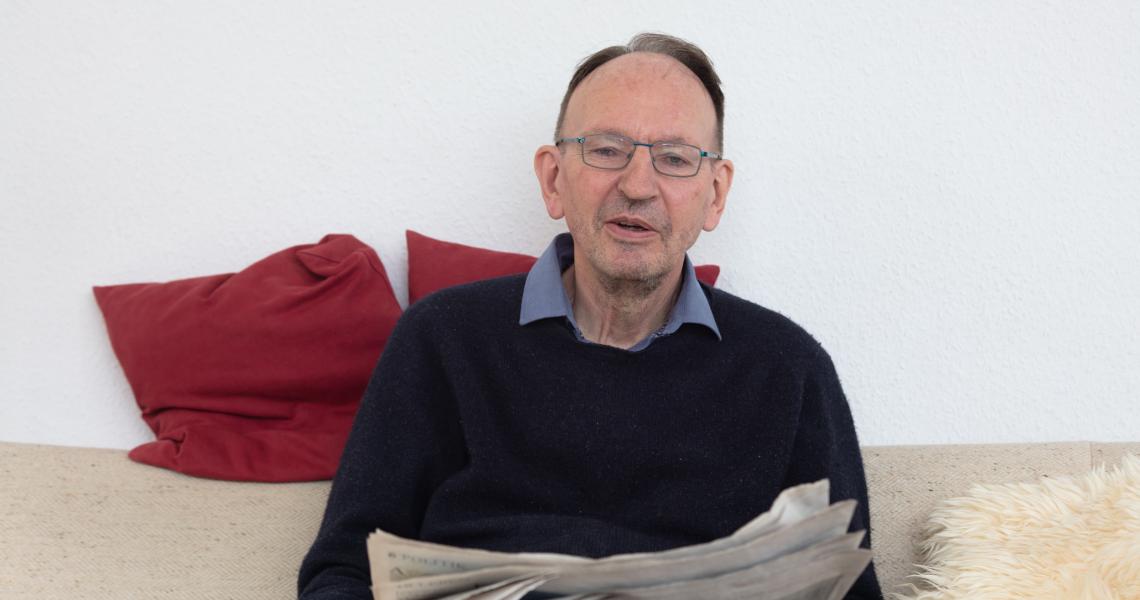
2026 Abel Prize recipient biography: Gerd Faltings
Gerd Faltings was born on July 28th 1954 in the Buer district of Gelsenkirchen, an industrial town in Germany ‘s Ruhrgebiet region. His parents both held Ph.D.s in science – his father in physics and his mother in chemistry. He later said that Physics was his first interest, but then he preferred mathematics “because things are either true or false, it’s not a matter of opinion.”[1]
In Gelsenkirchen he attended the Max-Planck-Gymnasium secondary school, where he won two national prizes in the Bundeswettbewerb Mathematik.
From 1972 he studied mathematics at the University of Münster, interrupted by 18 months of compulsory military service. With Hans Joachim Nastold as his supervisor he gained his Ph.D. in 1978 in Commutative Algebra, with a thesis titled "Über Macaulayfizierung" (On Macaulayfication).
Then followed a year as a research fellow at Harvard, thanks to a stipend from the German science foundation (DFG), specialising in algebraic geometry, and toroidal embeddings in particular.
Moving back to Münster in 1979, Faltings assisted H. J. Nastold until his habilitation[2] in 1981, with a focus on formal geometry and local cohomology.
He then moved to Wuppertal as a full Professor in 1982, aged 28. The following year, he proved the Mordell Conjecture – thus turning it into the Faltings Theorem – and “somehow became famous overnight.”[3] This theorem asserts the finiteness of rational points on algebraic curves of genus greater than one. The Göttingen Academy of Sciences and Humanities awarded him the Dannie-Heineman Prize.[4]
While working at Wuppertal, he met fellow mathematician Angelika Tschimmel, and they married in 1984. In 1985 Gerd took up a full Professorship at Princeton University in New Jersey, where their two daughters Christina and Ulrike were born. There he continued his research into toroidal compactifications and p-adic Hodge theory. With Gisbert Wűstholz he re-proved Roth’s Theorem on Diophantine Approximations of algebraic numbers.
In 1986, the International Congress of Mathematicians awarded him the Fields Medal[5] for his work in algebraic geometry. His work on the Mordell Conjecture – now the Faltings Theorem - continued, with the help of a Guggenheim Fellowship in 1988. Building on a new proof by Paul Vojta in 1989, Faltings proved the Mordell-Lang Conjecture, further generalising the Mordell results.
In 1994 Faltings and his family moved back to Germany where he took up a post as Scientific Member at the Max Planck Institute for mathematics[6] in Bonn.
As a director at the MPI since 1995, Faltings has enjoyed exceptional freedom to pursue his research. He continued his work on moduli spaces, introducing the concept of ‘almost étale coverings’ and collaborating with Chiang-Li Chai on the book "The Geometry of Moduli Spaces of Abelian Varieties".
Many more honours followed: The Gottfried Wilhelm Liebniz Prize in 1996; the Karl Georg Christian von Staudt Prize in 2008; the Heinz Gumin Prize in 2010; and the Georg Cantor Medal[7] in 2017. International Prizes too: the King Faisal International Prize for Science in 2014 for “seminal contributions to mathematics, particularly to algebraic geometry, number theory and arithmetic,”[8] and the Shaw Prize for Mathematical Sciences in 2015, shared with Henryk Iwaniec “for their introduction and development of fundamental tools in number theory, allowing them as well as others to resolve some longstanding classical problems.”[9]
Faltings is a member of the Academies of Düsseldorf, Gõttingen, Berlin and Halle, and in 2024 was elected a member of the Order Pour le Mérite[10][11], founded in 1842 and now awarded by the German federal government. In 2016 he became a Fellow of the UK Royal Society[12], and in 2018 a member of the National Academy of Sciences in the US[13].
In 2011 his wife Angelika sadly lost her life to cancer.
An emeritus director at the Max Planck Institute since 2023, Faltings continues his research in arithmetic geometry. Alongside his work, he enjoys opera, gardening, and collecting fine wines (and, presumably, drinking them).
Written for The Abel Prize by Timandra Harkness
[1] https://www.shawprize.org/en/prizes-laureates/mathematical-sciences
[2] A German qualification needed to become full Professor
[3] https://www.shawprize.org/en/prizes-laureates/mathematical-sciences
[4] https://adw-goe.de/en/academy/awards-prizes/dannie-heineman-prize/
[5] The Fields Medal is one of the highest honours in Mathematics, awarded only every four years to an outstanding mathematician under 40.
[6] https://www.mpim-bonn.mpg.de/taxonomy/term/136
[7] https://www.mathematik.de/preistraeger/preise-und-auszeichnungen
[8] https://kingfaisalprize.org/professor-gerd-faltings/
[9] https://www.shawprize.org/en/prizes-laureates/mathematical-sciences
[10] https://www.orden-pourlemerite.de/mitglieder/gerd-faltings
[11] https://www.uni-bonn.de/en/news/gerd-faltings-given-prestigious-honor
[12] https://royalsociety.org/people/gerd-faltings-12864/
[13] https://www.nasonline.org/directory-entry/gerd-faltings-567hyn/