An introduction to the laureate's work
by Timandra Harkness
Numbers.
The basic stuff of mathematics. You can add them, multiply them, multiply them by themselves (square them) any number of times (cube them, or raise them to higher powers). You learnt all the basic rules to do that at school.
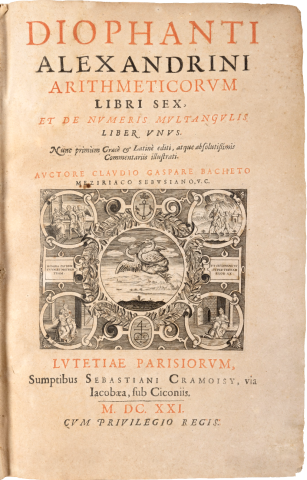
Number Theory is one of the oldest branches of mathematics. Back in the 3rd Century CE, a mathematician called Diophantos of Alexandria introduced some problems that are still giving mathematicians headaches today.
Because, although the rules of how numbers behave when you add or subtract them, or when you multiply or divide them, seem simple, when you start to mix multiplication and addition, numbers get very mysterious.
Diophantine equations have more than one unknown variable – represented by a, b, x, y, and so on – and solutions that can be expressed as integers – whole numbers.
Download article (pdf)
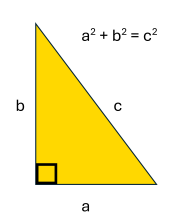
Pythagoras’ theorem is a diophantine equation: a2 + b2 = c2 . The whole number solutions for a, b, and c are called the Pythagorean Triples. And there are infinitely many of them, starting with 3, 4 and 5.
But what if, instead of squaring a, b and c, you cube them? Not so easy to solve. In fact, Fermat’s last theorem (which he wrote in the margin of his copy of Diophantos’ book on arithmetic) says that there are no diophantine solutions for an + bn = cn if n is greater than 2.
And sure enough, for hundreds of years, nobody was able to find any whole number solutions if n is 3 or more (if the equation has degree 3 or higher). Various mathematicians including Euler, Sophie Germain, Dirichlet and Legendre managed to prove Fermat right for specific cases. But it took from 1637 until 1995, for Abel Prize winner Andrew Wiles to prove that there can’t be any such solutions for any n greater than 2.
Watch: Thirty years of proof: an interview with Andrew Wiles on the anniversary of Fermat's Last theorem (YouTube)
One way for mathematicians to understand the deeper patterns of numbers is to represent them as geometric shapes. This is the field of arithmetic geometry.
Equations can be expressed as sets of points, by turning the equation into a function and plotting the solutions as co-ordinates. So the equation 𝑥2 + 𝑦2 – 1 = 0 , can be expressed as 𝑓(𝑥,𝑦)=𝑥2+𝑦2-1 and then we study where this function equals zero, or 𝑓(𝑥,𝑦)=0.
If we plot this on a flat sheet of paper it gives us a circle, passing through the points where 𝑥 = 1 or -1 and 𝑦 = 0, and the points where 𝑥 = 0 and 𝑦 = 1 or -1. Try it yourself - put 𝑥2 + 𝑦2 – 1 = 0 in the first box: https://www.desmos.com/calculator
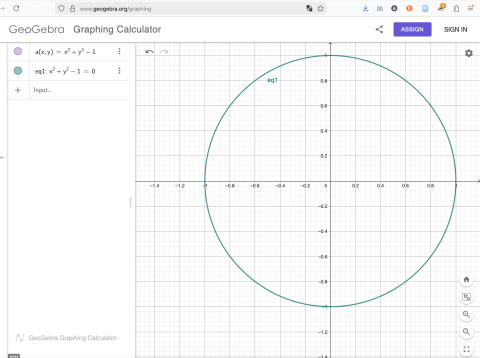
Any point on that circle gives us values for x and y which solve the equation, but those four integer solutions are obvious, or trivial as mathematicians would say. And they are the only whole number solutions.
But we can find infinitely many rational numbers 𝑥 and 𝑦 that satisfy this equation. For example, x = 3/5 (0.6) and y = 4/5 (0.8) is a solution. In fact, if you’re prepared to make the numerator and the denominator large enough, there are an infinite number of rational points on the curve.
They’re called rational numbers not because they behave in a sensible way, but because they can be expressed as a ratio between two whole numbers – also known as fractions.
But far more of the points on this curve are irrational numbers, so called because they cannot be expressed as a ratio between two whole numbers, though they may be approximated by fractions, if you make the denominator big enough. This is diophantine approximation.
If that sounds bizarre, think of the irrational number Pi: its true value cannot be expressed as a fraction, but for practical purposes we can approximate it as 22/7, or 3.142 (3,142/1,000). The closer we want to get to its true value, the greater the numerator and denominator need to become: 104,348/33,215 for example.
So that equation, x2 + y2 – 1 = 0, has integer solutions, rational solutions and irrational solutions. But if we change the power to three, x3 + y3 – 1 = 0, there are no positive rational solutions.
Difficult equations involving both multiplication and addition can be expressed as curves in number fields. A field is a set of numbers with some rules for how the numbers behave when we add or multiply them, or try to put them in some kind of order. The number field ℚ, for example, includes all the rational numbers – that’s ℚ for quotient. The complex numbers, which include i (the square root of minus 1) form the number field ℂ.
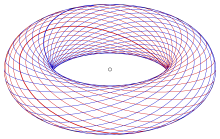
A polynomial equation includes different powers of the same variable - like x3 + 3x2 – x + 1 = 0. The higher the powers, the greater the degree of the equation, and from the degree we can determine the genus – which tells us how many holes there will be in the curve.
Elliptic curves are given by cubic equations, such as y2 = x3 + ax + b, so they have degree 3. That means they belong to genus 1, and the curve defined by f(x,y,z) = 0 for the corresponding function
f(x,y,z) = y2z – x3 – axz2 – bz3 is a torus and has one hole. Andrew Wiles used elliptic curves when he proved Fermat’s Last theorem.
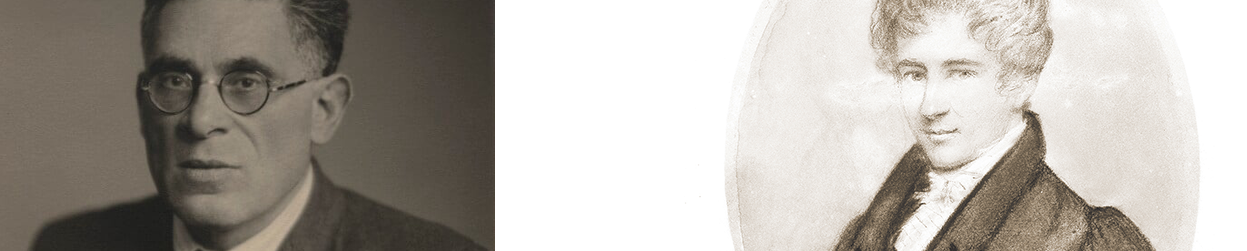
In 1922 Louis J. Mordell proved that the rational points on an elliptic curve are generated by a finite group of points that behave in predictable ways. In fact, the rational points form an Abelian Group, as discovered by Niels Henrik Abel, whose work keeps turning out to be central to great mathematical ideas, and after whom this prize is named.
But what about curves of genus 2 or more, described by equations with higher powers? Unfortunately, they don’t follow such straightforward rules.
Mordell conjectured that such curves only have a finite number of rational points, but he was unable to prove it.
In 1983, Gerd Faltings proved related conjectures by Shafarevitch and Tate about finiteness of curves. This – as Parshin had already predicted it would – also proved Mordell’s conjecture, which is now known as Faltings’s theorem.
Faltings’ method surprised many people, because he did not use diophantine approximation, but took ideas from Tate, Parshin and Szpiro to develop methods in arithmetic geometry using classification of algebraic curves.
He also had to refine a measure of the complication of a rational number called Height – broadly, the minimum length of numerator or denominator that exactly defines the number. Strictly speaking, Faltings’s theorem shows that the higher-order curves have only a finite number of rational points below a bounded Faltings Height.
Later, Paul Vojta did use diophantine approximation to obtain a new proof, and this gave Faltings new directions for research. He used the new tools to establish Faltings’s Product theorem, which he then used to prove the Mordell-Lang conjecture about the distribution of rational points.
Faltings’s work in arithmetic geometry continues to resolve longstanding questions and establish new frameworks for uniting geometry and number theory.